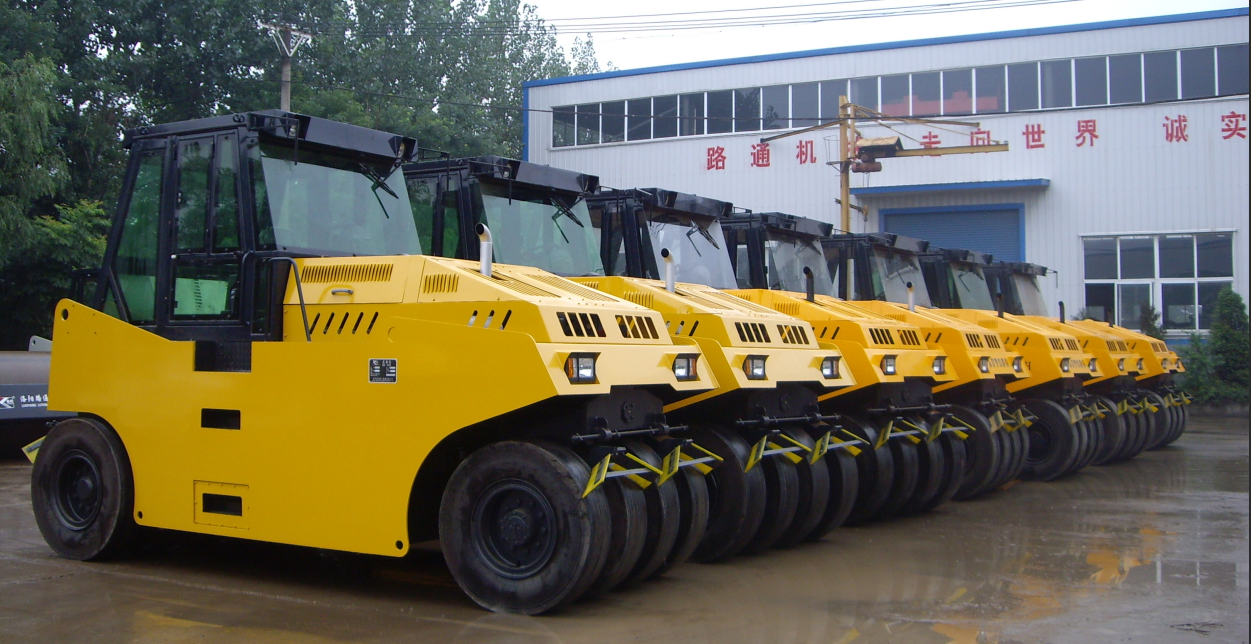
Rubber wheel rollers, also known as rubber tire rollers or pneumatic rollers, are core road compaction equipment widely used in road construction, airport pavement, municipal engineering and other fields, mainly for the compaction of asphalt pavement, cement stabilized base and various soil layers. Compared with steel wheel rollers, this kind of road compaction equipment features flexible compaction, uniform pressure and no crack on the pavement surface. To standardize the safe use of rubber wheel roller in road construction, ensure construction quality, extend equipment service life and guarantee personal operation safety, it is necessary to strictly follow the rubber wheel roller construction safety rules and safety operation standards throughout the whole construction process. This article summarizes professional rubber wheel roller operation precautions and daily maintenance guidelines for construction reference.
1. Pre-operation Inspection and Preparation
Sufficient pre-operation inspection of rubber wheel roller is the foundation of safe and efficient construction. Before starting the rubber tire roller, operators must conduct a comprehensive inspection of the whole equipment to eliminate potential faults in advance and comply with construction roller safety operation principles.
First, check the basic operating parameters of the equipment. Verify the tire pressure of all rubber wheels strictly in accordance with the equipment manual. Excessively high tire pressure will cause local over-compaction and pavement damage, while excessively low pressure will lead to uneven compaction density and tire deformation. Meanwhile, check the wear condition of rubber tires; replace severely worn, cracked or aging tires in time to avoid tire burst during operation.
Second, inspect the mechanical system. Check the oil level of engine lubricating oil, hydraulic oil and fuel tank to ensure the liquid level is within the standard range, and avoid oil shortage operation that causes equipment wear and failure. Test the braking system, steering system and hydraulic lifting system to confirm flexible and sensitive operation without jamming or failure. In addition, check whether the connecting bolts of each component are loose, and fasten the loose parts timely.
Third, prepare the construction site and personal protection. Clean up obstacles such as stones, iron blocks and sundries on the construction pavement to prevent them from scratching rubber tires and affecting compaction flatness. Operators must hold valid certificates and wear standardized labor protection clothes, anti-slip shoes and other protective supplies, and prohibit wearing loose clothes or slippers to avoid safety accidents, fully implementing rubber tire roller safety operation guidelines.
2. Key Rubber Wheel Roller Working Operation Notes
The formal operation process is the core link affecting asphalt pavement compaction quality and construction safety, and operators must strictly abide by asphalt pavement compaction roller operation specifications and avoid irregular operations.
During the starting and running process, start the engine at a low speed first, and warm up the equipment for 3 to 5 minutes to ensure the hydraulic system and engine work stably before formal compaction operation. It is forbidden to start abruptly, accelerate sharply or brake suddenly, so as to prevent sudden impact force from causing equipment structural damage and pavement unevenness. The running speed of the roller shall be controlled stably according to the construction requirements; usually, the compaction speed of asphalt pavement is maintained at 4 to 6 km/h, excessive speed will lead to insufficient compaction density, while too low speed will affect construction efficiency.
In terms of compaction operation specifications, follow the principle of "first low then high, first slow then fast, first edge then middle". For road slope and edge positions, reduce the running speed appropriately and avoid rolling over the road edge to prevent side slipping and tipping. When conducting overlapping rolling, control the overlapping width of the rolling track uniformly (generally 1/3 to 1/2 of the tire width) to ensure no missing rolling and uniform pavement compaction. It is forbidden to turn, reverse or stop randomly on the freshly compacted pavement, so as not to cause pavement indentation, wrinkling and deformation.
For special working conditions, targeted protection shall be done. When constructing in high-temperature environment, regularly check the tire temperature to avoid tire aging and damage caused by long-time high-load friction. When working on wet or muddy pavement, reduce the driving speed and avoid long-time parking to prevent tire skidding and pavement muddy damage. In addition, do not carry out rolling operation on unqualified loose pavement to avoid equipment sinking and construction quality problems. Mastering professional pneumatic roller operation safety tips can effectively reduce on-site construction risks.
3. Post-maintenance of Rubber Tire Roller and Parking Precautions
Standard post-operation maintenance can effectively extend the service life of rubber wheel compactors and reduce failure rates. Daily operation and maintenance of construction rollers is an indispensable part of standardized construction, and thorough cleaning and maintenance of the equipment must be carried out after daily construction work.
First, clean the equipment surface completely. Remove asphalt residue, soil, dust and sundries adhered to rubber tires and the fuselage in time. Long-term adhesion of asphalt and dirt will corrode rubber tires, accelerate aging and affect tire elasticity and compaction effect. Clean the hydraulic components and engine surface to ensure good heat dissipation of the equipment.
Second, conduct daily inspection and maintenance. Check the oil and water level again, replenish lubricating oil and cooling water in time if insufficient. Check the wear of tires, bearings and transmission parts, and record abnormal conditions for timely maintenance. Tighten the loose connecting parts and lubricate the rotating and friction components to keep the equipment in good operating condition.
Third, standardize rubber wheel roller parking and maintenance precautions. Park the roller on a flat, solid and dry ground, and avoid long-term parking on sloped, soft and muddy pavement to prevent equipment sliding and tire deformation. Before parking, turn off all operating systems, idle the engine for 2 to 3 minutes to cool down, and then turn off the engine and cut off the power. Do not park the equipment on the freshly compacted pavement to avoid leaving permanent indentations and damaging the pavement flatness.
4. General Safety Operation Principles
Operators must hold valid operation certificates and receive professional pre-job training before taking up their posts. It is strictly forbidden for untrained personnel to operate the equipment independently. During the operation, concentrate on working conditions, observe the surrounding environment in real time, and pay attention to pedestrians and other construction machinery to avoid collision accidents.
It is forbidden to modify the equipment parameters and operation mode without authorization, and do not overload the roller for operation. When the equipment fails during operation, stop the machine immediately for inspection and maintenance. It is strictly forbidden to operate the equipment with faults. In case of emergency, cut off the power and brake in time to ensure personal and equipment safety, strictly abiding by road compaction equipment operating precautions.
Conclusion
The standardized operation of rubber wheel rollers is directly related to road construction quality, construction safety and equipment service life. All operators must strictly implement pre-operation inspection, standardized in-operation construction and scientific post-maintenance specifications, abide by safety operation disciplines, and standardize every operation link. Only by strictly following rubber wheel roller operation precautions can we effectively avoid construction quality problems and safety accidents, ensure uniform pavement compaction effect, and guarantee the smooth progress of road engineering construction.