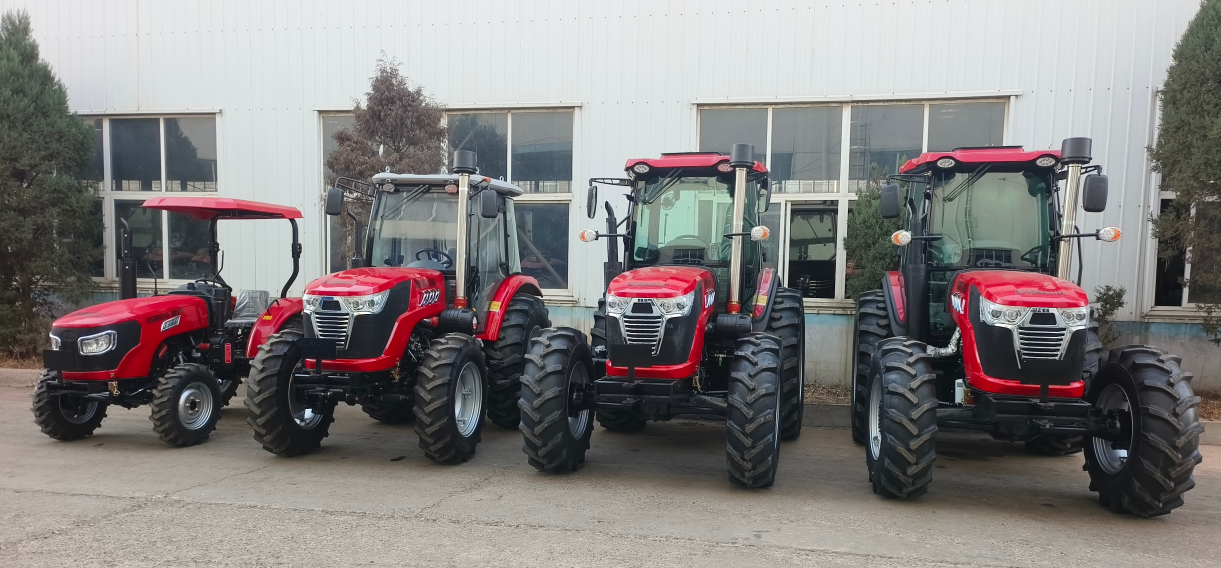
Picking the perfect tractor for your farm or land is the key to maximizing farming efficiency, cutting operating costs, and avoiding unnecessary equipment waste. Many landowners make the mistake of choosing an over-powered bulky tractor for small plots or an underpowered compact model for large farmland, leading to low productivity, high fuel consumption, and frequent mechanical failures.
Land acreage is the most reliable and straightforward benchmark for selecting a suitable tractor. Combined with working scenarios, horsepower matching, and terrain conditions, you can easily find the ideal tractor for your land. This detailed guide will help you select a cost-effective, high-performance tractor tailored to different land sizes.
1. Tractor Selection for Small Land (1–10 Acres)
Recommended HP Range: 18–35 HP
Best Tractor Type: Sub-compact & Compact Tractors
Small land including home gardens, small vegetable plots, orchards, and hobby farms requires flexible, lightweight tractors with a small turning radius. Tractors in 18–35 HP are compact in size, easy to maneuver in narrow rows and tight corners, and will not damage soft farm soil or crop roots. They are lightweight, low fuel-consuming, and easy to maintain, perfectly matching daily light farm tasks.
Main Applicable Work: Lawn mowing, light tillage, seeding, small-scale fertilization, farmland cleaning, and small-load transportation. Ideal for personal hobby farms and family small-scale planting scenarios.
2. Tractor Selection for Medium-Small Land (10–25 Acres)
Recommended HP Range: 35–60 HP
Best Tractor Type: Compact Utility Tractors
For 10 to 25 acres of farmland with diversified planting needs, compact utility tractors are the most cost-effective choice. Balancing flexibility and power, these tractors support multiple attachments and can handle both fine farm work and medium-intensity field operations. Most models support 4WD optional configuration, adapting to slightly rugged terrain and wet soil conditions.
Main Applicable Work: Rotary tilling, plowing, harrowing, crop planting, hay baling, loader lifting, and medium-distance material transportation. Perfect for diversified family farms and small livestock farms.
3. Tractor Selection for Medium Land (25–100 Acres)
Recommended HP Range: 60–100 HP
Best Tractor Type: Standard Utility Tractors (4WD Preferred)
25 to 100 acres of commercial farmland requires tractors with stable power, high working efficiency, and strong load capacity. 60–100 HP utility tractors feature durable frames, strong traction, and excellent implement compatibility, supporting continuous long-hour operation. The standard 4WD design ensures outstanding performance on uneven land, sloped fields, and sticky soil.
Main Applicable Work: Heavy tillage, large-area sowing, crop harvesting assistance, bulk material handling, field leveling, and regular farm maintenance. Suitable for professional family farms and small-scale commercial planting bases.
4. Tractor Selection for Large Land (100–200 Acres)
Recommended HP Range: 100–160 HP
Best Tractor Type: High-Power Farm Tractors
Large-scale farmland above 100 acres pursues high working efficiency and low unit operating cost. 100–160 HP high-power tractors are matched with wide-working agricultural implements, greatly improving single-operation coverage and shortening the farming cycle. Equipped with advanced transmission systems and hydraulic control systems, they realize precise and efficient farm operations.
Main Applicable Work: Large-area deep plowing, land reclamation, wide-width seeding, unified crop management, and large-volume farm transportation. Designed for standardized large-scale agricultural production.
5. Tractor Selection for Super Large Commercial Land (Over 200 Acres)
Recommended HP Range: 160–240 HP+
Best Tractor Type: Heavy-Duty Commercial Tractors
For industrialized agricultural bases and super-large farms over 200 acres, only heavy-duty high-power tractors can meet intensive, high-frequency, and high-load farming needs. These tractors feature super strong traction, ultra-high working efficiency, and good compatibility with large-scale supporting equipment, helping farms realize full mechanization and intelligent farming.
Main Applicable Work: Heavy land tillage, large-scale crop rotation, mechanical harvesting matching, long-distance bulk cargo transportation, and farm infrastructure construction.
Key Bonus Tips for Tractor Selection
1. Match Terrain Conditions: For sloped, wet, or rugged land, prioritize 4WD tractors for better grip and stability, even with slightly lower horsepower.
2. Consider Implement Compatibility: Confirm the tractor’s hydraulic lift capacity and PTO power to match your commonly used farm attachments (plow, harrow, loader, baler).
3. Balance Power and Fuel Economy: Avoid overbuying high-horsepower tractors for small land, which causes excess fuel consumption and waste; underpowered tractors will increase machine wear.
4. Prioritize Durability and After-sales: Choose tractors with stable quality, easy maintenance, and complete after-sales support to reduce long-term operating costs.
Conclusion
Acreage is the core standard for tractor selection. Small plots need flexible compact tractors, medium farms need versatile utility tractors, and large commercial land requires high-power heavy-duty tractors. Choosing a tractor that perfectly matches your land size can maximize farming efficiency, save time and fuel costs, and extend the service life of agricultural equipment. Pick your ideal tractor according to your land area and farming needs to boost your farm productivity instantly!